



$685.39
Named for the man Baltimore buried
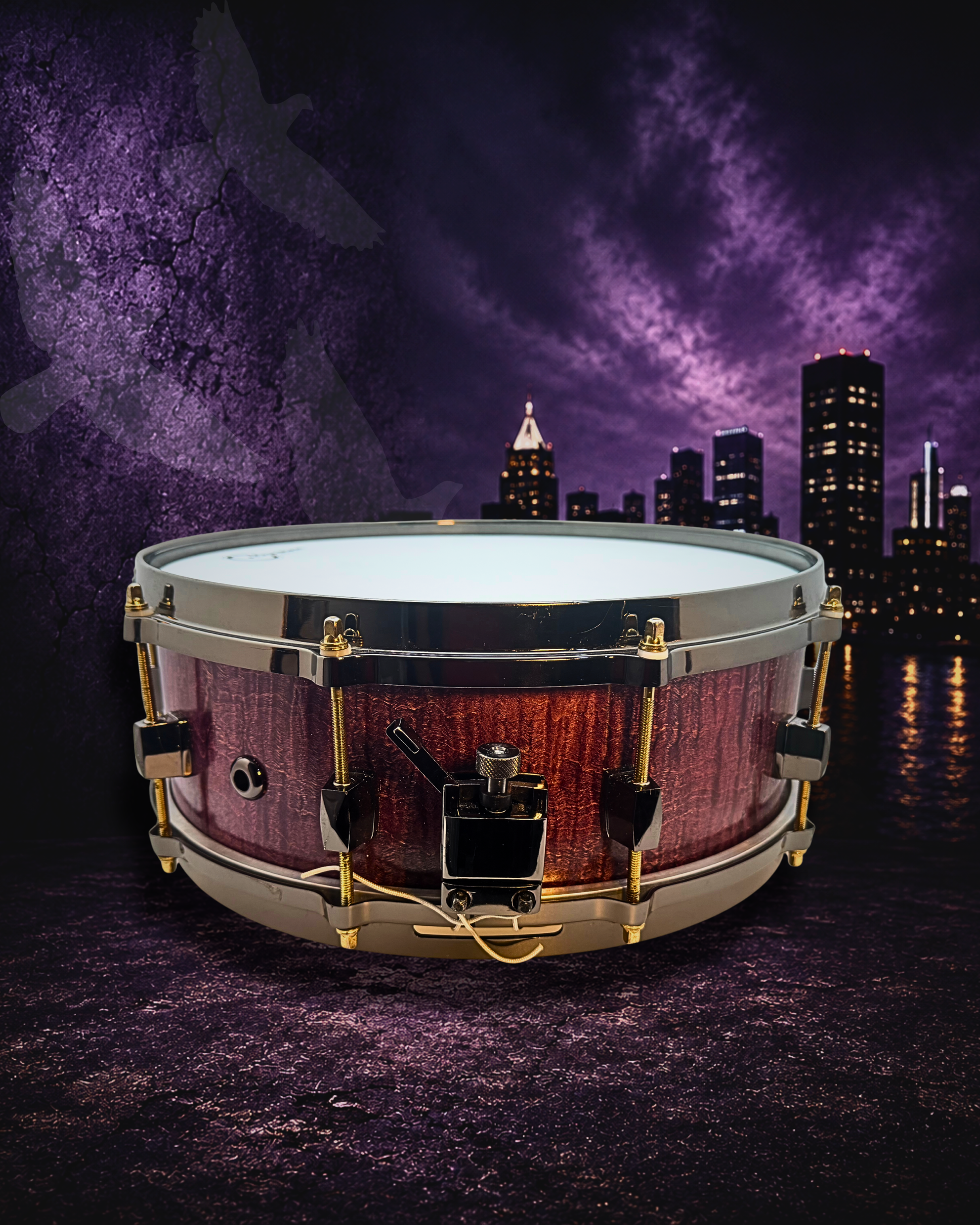
Edgar Allan Poe died in this city in 1849 and never left it. He's in a churchyard on West Fayette Street, about two miles from where this drum was built.
We build in Baltimore. When a shell came out of the press with figure like this one, the name wasn't a hard call.
The wood
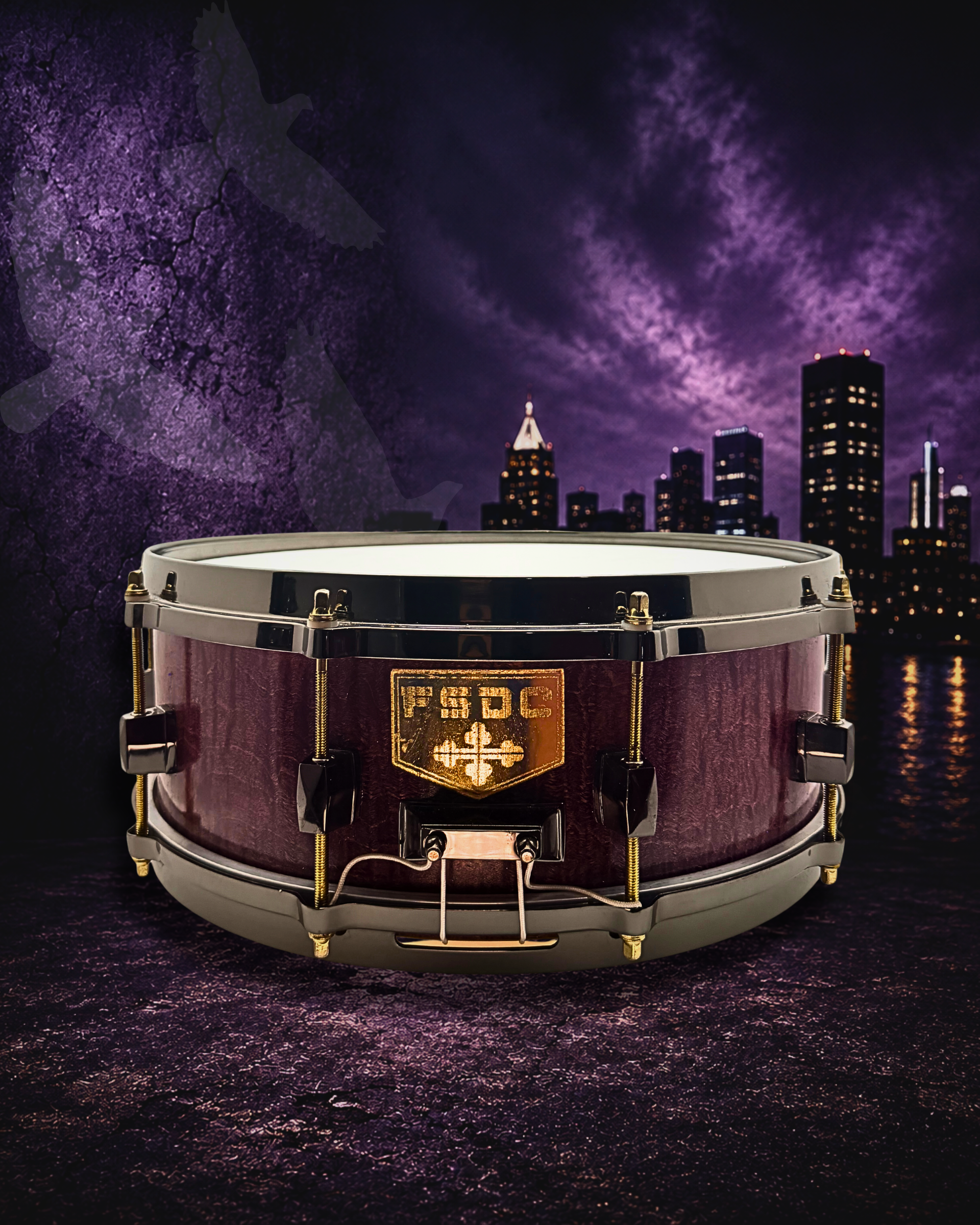
The outer ply is curly maple — figured wood, where the grain runs in tight waves instead of straight lines. Under the high-gloss clear it moves: shift your head, or let a stage light travel across it, and the stripes appear to roll across the shell like the surface of water. It isn't printed and it isn't a wrap. It's what the tree did, and no two boards do it the same way.
Beneath it, nine more plies of maple — ten total. That's a thick, stiff shell by any standard, and it does a specific job: it holds its shape at high tension and throws the energy back at you instead of absorbing it. This is not a delicate drum.
Finished in triple-thick clear gloss polyurethane, built up and cured to a wet-looking depth that puts the figure under glass rather than over it.
Die-cast hoops, top and bottom
This is the spec that defines how the drum sounds, and it's the rarest thing on the build.
Most snares that advertise die-cast hoops have one — on the batter side, where you can see it. The Poe has die-cast on both heads, in black nickel.
A die-cast hoop is poured and machined as a single solid piece, rather than rolled from sheet steel. It's heavier, dead rigid, and it clamps the head down hard around the whole circumference. What that does to the sound:
- The overtones go away. The ring that a triple-flange hoop lets breathe gets cut off. What's left is fundamental and attack.
- The rimshot gets louder and drier. A crack instead of a clang. It's the sound most engineers want and most drummers have to fight their hardware to get.
- The tuning locks. A rigid hoop applies even pressure and doesn't flex, so the pitch you set is the pitch you have three sets later.
Running die-cast on the snare side as well tightens the wire response the same way — quicker, more defined, less wash underneath the note.
Understand the trade: this is a focused, controlled, dry drum, not a ringing one. A ten-ply shell and two die-cast hoops both pull in the same direction. If you're looking for a snare that sings and blooms behind the note, this isn't that drum, and we'd rather tell you now than sell you the wrong one. If you want power, definition, and a backbeat that lands like a door slamming, keep reading.
Hardware
- Ten small double-sided die-cast lugs in black nickel. Compact, low-mass lugs, so less hardware sits against the shell than the hoop weight alone would suggest — the shell keeps more of its own voice.
- Twenty brass tension rods, two lengths cut for the two hoops. Brass against black nickel is the whole visual idea: warm metal on cold.
- Black nickel throw-off and butt plate, matched to the hoops.
- 14" 20-strand black snare wire. Twenty strands runs dry and focused — the right count for a drum this controlled, and the black finish keeps the underside as considered as the top.
- Black threaded air vent, with the FSDC badge.
One of one
The Poe is a pre-built YOURdrum. Nobody commissioned it. It exists because a piece of curly maple came through the shop that was too good to sit on a shelf.
Figure never repeats. Even from the same tree, the next shell won't look like this one — so this drum happens exactly once.
Built by hand in Baltimore, Maryland. Veteran owned.
Semper Doctrina